Math - Students continued work on identifying the relationship between decimals, percentages, and fractions. A large part of this work focused on equivalent fractions and how to multiply or divide to put fractions in their lowest terms or to make the denominator 100 in order to make easy conversions to the other forms.
Moving forward students will be doing work on operations involving decimal numbers and learning about the order of operations (PEDMAS).
Science - Students finished the week by completing their flight adaptation posters focusing on birds and insects and the forces of flight associated with different adaptations. Students are completing posters that demonstrate their understanding of the properties of air - air exerts pressure (including the difference in pressure at different altitudes), air takes up space, air is affected by temperature, air can be compressed, and air has weight. Students should work to have these completed by the end of next week.
We will be moving on to looking at propulsion of animals and aircraft, the parts of an airplane, and the movements related to these parts.
Practice supports and review materials can be found at:
D2L
If you need any help or are looking for supports not found here, please let me know at:
sthompson@cbe.ab.ca
Friday, January 31, 2020
Friday, January 24, 2020
Week ending January 24, 2020
Math - students completed work around number concepts that involved writing/reading numbers in different forms:
STANDARD FORM - 2 387 364
NUMBER WORDS - two million three hundred eighty-seven thousand three hundred sixty-four
EXPANDED NOTATION - 2 000 000 + 300 000 + 80 000 + 7 000 + 300 + 60 + 4
They also explored these concepts using decimal numbers. Students should be able to read/write numbers up to the billions place value and down to the thousandths.
Students should also be able to use their understanding of place value to order numbers from greatest to least or least to greatest.
The following link can be used to review many of these concepts.
Math Aids - Number concepts
We are currently exploring the relationships between fractions, decimals, and percentages. Work in this area will focus on being able to create equivalent fractions with a denominator of 100.
Science - Students have spent the last week learning about adaptations that birds and insects have developed to help them fly. They then needed to determine which forces of flight that these adaptations relate to (Lift, Thrust, Drag, Weight/Gravity). They will complete a poster using this information due Tuesday of next week.
Information about the assignment, as well as links that can be used to find information can be found using D2L.
D2L
Upcoming work will look at how streamlining objects helps reduce drag and also the parts of an airplane and how some of them help the plane to make movements in the air.
STANDARD FORM - 2 387 364
NUMBER WORDS - two million three hundred eighty-seven thousand three hundred sixty-four
EXPANDED NOTATION - 2 000 000 + 300 000 + 80 000 + 7 000 + 300 + 60 + 4
They also explored these concepts using decimal numbers. Students should be able to read/write numbers up to the billions place value and down to the thousandths.
Students should also be able to use their understanding of place value to order numbers from greatest to least or least to greatest.
The following link can be used to review many of these concepts.
Math Aids - Number concepts
We are currently exploring the relationships between fractions, decimals, and percentages. Work in this area will focus on being able to create equivalent fractions with a denominator of 100.
Science - Students have spent the last week learning about adaptations that birds and insects have developed to help them fly. They then needed to determine which forces of flight that these adaptations relate to (Lift, Thrust, Drag, Weight/Gravity). They will complete a poster using this information due Tuesday of next week.
Information about the assignment, as well as links that can be used to find information can be found using D2L.
D2L
Upcoming work will look at how streamlining objects helps reduce drag and also the parts of an airplane and how some of them help the plane to make movements in the air.

Friday, January 10, 2020
Week ending January 10, 2020
Happy New Year!!
Welcome back to school. I hope everyone had an enjoyable winter break.
Student progress can be viewed through PowerSchool. If you have not yet done so, be sure to set up an account. Instructions can be found through the links on the following site:
MyCBE Powerschool
Math: We are currently doing work around the Number unit, focusing specifically on place value and how to read and write numbers in a variety of ways (students should be able to read and write numbers into the billions and the ten thousandths). They will also work around understanding the value of a particular number based on its place value and how to determine if numbers are greater or less than others.
There are many sites online that could support practice at home. Feel free to try the one below:
Place Value - Khan Academy
Science: Students will be wrapping up their look at the properties of air. This week we looked at how air is fluid like water and how the movement of air affects the pressure it exerts. We also looked at how temperature affects air. Use the following page as a helpful review for these topics:
Properties of air
Any questions, please feel free to contact me by email at sthompson@cbe.ab.ca
Welcome back to school. I hope everyone had an enjoyable winter break.
Student progress can be viewed through PowerSchool. If you have not yet done so, be sure to set up an account. Instructions can be found through the links on the following site:
MyCBE Powerschool
Math: We are currently doing work around the Number unit, focusing specifically on place value and how to read and write numbers in a variety of ways (students should be able to read and write numbers into the billions and the ten thousandths). They will also work around understanding the value of a particular number based on its place value and how to determine if numbers are greater or less than others.
There are many sites online that could support practice at home. Feel free to try the one below:
Place Value - Khan Academy
Science: Students will be wrapping up their look at the properties of air. This week we looked at how air is fluid like water and how the movement of air affects the pressure it exerts. We also looked at how temperature affects air. Use the following page as a helpful review for these topics:
Properties of air
Any questions, please feel free to contact me by email at sthompson@cbe.ab.ca
Wednesday, December 18, 2019
Week ending December 13, 2019
Math - Students have begun to learn about basic probabilities through work with spinners, dice, and cards. Students have learned that there is a difference between theoretical and experimental probability. Students have learned that probabilities are expressed as fractions (later we will focus on being able to represent them as decimals and percents) and that these probability fractions are frequently written in their lowest terms. Because of this students have learned how to apply division to determine equivalent fractions in their lowest terms. They have also learned how to use multiplication to determine the number of possible outcomes that should be expected for a given set of trials.
Practice is ongoing for computation using whole numbers in all operations (addition, subtraction, multiplication, division).
Sites that may be useful for review can be found at:
D2L
and if you have a public library card
Solaro curriculum review
Science - Students have done activities in class to learn about the properties of air. Some of these properties include that air exerts pressure, air has weight, air takes up space, and air can be compressed. Future work will look at how air moves and how the pressure difference allows birds and airplanes to fly.
Review material can be found at
D2L
and
Properties of air review
Practice is ongoing for computation using whole numbers in all operations (addition, subtraction, multiplication, division).
Sites that may be useful for review can be found at:
D2L
and if you have a public library card
Solaro curriculum review
Science - Students have done activities in class to learn about the properties of air. Some of these properties include that air exerts pressure, air has weight, air takes up space, and air can be compressed. Future work will look at how air moves and how the pressure difference allows birds and airplanes to fly.
Review material can be found at
D2L
and
Properties of air review
Monday, November 25, 2019
Week ending November 22, 2019
Math - Students have been learning how to calculate the volume of right rectangular prisms and cubes.
Students use the formula to calculate volume as Volume = length x width x height
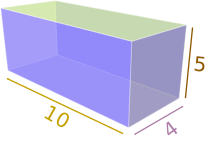
the volume of this shape would be 10 units x 4 units x 5 units = 200 cubic units.
Students are working towards solving more complex problems around this topic, such as finding a missing dimension when a volume is given, comparing various prisms, and figuring out how many smaller prisms can fit inside a larger one.
Students are encouraged to regularly practice operational questions in addition, subtraction, and multiplication.
Science - Students have begun to explore concepts in our Air and Aerodynamics unit beginning with the composition of our air. A poster presentation assignment is what they have spent the last week working towards, using class time to research information about the various gasses and their percentage in our air.
Air composition assignment
Students are being asked to complete these projects for Friday the 29th of November.
Students use the formula to calculate volume as Volume = length x width x height
the volume of this shape would be 10 units x 4 units x 5 units = 200 cubic units.
Students are working towards solving more complex problems around this topic, such as finding a missing dimension when a volume is given, comparing various prisms, and figuring out how many smaller prisms can fit inside a larger one.
Students are encouraged to regularly practice operational questions in addition, subtraction, and multiplication.
Science - Students have begun to explore concepts in our Air and Aerodynamics unit beginning with the composition of our air. A poster presentation assignment is what they have spent the last week working towards, using class time to research information about the various gasses and their percentage in our air.
Air composition assignment
Students are being asked to complete these projects for Friday the 29th of November.
Tuesday, November 19, 2019
Week ending Nov. 15, 2019
Math - Students are concluding their work around area and did practice with multiplication questions that involved 2 digit by 1 digit and 3 digit by 1 digit whole numbers. Students are encouraged to regularly review past topics in order to help them retain their understanding of the work done in class. Many review tools can be found through a general Google search or students can access some through the D2L link.
D2L
Students with a Calgary Public Library card can also access another supportive review tool as long as they know their PIN number by signing up through the following link:
Solaro link through Calgary Public LIbrary
We will be moving into work around volume and multiplication of 2 digit by 2 digit whole numbers.
Science - Students have completed their work on the Evidence and Investigation unit and will be moving into Air and Aerodynamics, starting with a project looking at the gas composition of the air that we breathe. The information for this project can be found here:
Air composition assignment
Students will be given a large amount of class time to research and work on this assignment but should be prepared to complete work outside of class time if necessary.
Moving forward we will be investigating the properties of air through demos and activities in class.
Information about these science topics can be found through the public library link mentioned in math above. Students would benefit from regular review of previous topics in order to help them retain their understanding.
D2L
Students with a Calgary Public Library card can also access another supportive review tool as long as they know their PIN number by signing up through the following link:
Solaro link through Calgary Public LIbrary
We will be moving into work around volume and multiplication of 2 digit by 2 digit whole numbers.
Science - Students have completed their work on the Evidence and Investigation unit and will be moving into Air and Aerodynamics, starting with a project looking at the gas composition of the air that we breathe. The information for this project can be found here:
Air composition assignment
Students will be given a large amount of class time to research and work on this assignment but should be prepared to complete work outside of class time if necessary.
Moving forward we will be investigating the properties of air through demos and activities in class.
Information about these science topics can be found through the public library link mentioned in math above. Students would benefit from regular review of previous topics in order to help them retain their understanding.
Friday, November 8, 2019
Week ending Nov.7, 2019
Math - students have been learning how to determine the area of a rectangle or square by applying the formula of length x width. Problems involving determining the missing side length of a given rectangle after being given the area have also been explored.
Students also did some work around multiplication of 2 digit by 1 digit numbers with a focus being on how to multiply using multiples of 10.
Students can access practice in these areas by using the following links:
Multiplication practice sheet generator
Area and perimeter practice sheet generators
Science - students have wrapped up their study around Evidence and Investigation and completed a unit review exam this week. Students are encouraged to regularly review this material throughout the year because it will come up again regularly and as we approach closer to the Provincial Achievement exams.
Our next unit will be Air and Aerodynamics which ties in closely with the unit of Flight. Some of the initial topics we will be exploring include air composition and properties of air.
Review materials for all science topics can be located through my D2L page:
D2L
and found under the content section of PAT practice questions -> Science Unit Reviews
Please feel free to contact me anytime if you have any questions at:
sthompson@cbe.ab.ca
Students also did some work around multiplication of 2 digit by 1 digit numbers with a focus being on how to multiply using multiples of 10.
Students can access practice in these areas by using the following links:
Multiplication practice sheet generator
Area and perimeter practice sheet generators
Science - students have wrapped up their study around Evidence and Investigation and completed a unit review exam this week. Students are encouraged to regularly review this material throughout the year because it will come up again regularly and as we approach closer to the Provincial Achievement exams.
Our next unit will be Air and Aerodynamics which ties in closely with the unit of Flight. Some of the initial topics we will be exploring include air composition and properties of air.
Review materials for all science topics can be located through my D2L page:
D2L
and found under the content section of PAT practice questions -> Science Unit Reviews
Please feel free to contact me anytime if you have any questions at:
sthompson@cbe.ab.ca
Thursday, October 31, 2019
Week ending Oct. 31, 2019
Math - Students are wrapping up their study of perimeter and will be moving into area next week. Area will focus specifically on rectangles and squares. Multiplication practice would be an additional support to this upcoming work.
Science - Students completed their look at DNA as evidence and participated in a classroom lab that demonstrated a basic form of chromatography. Students will wrap up this activity next week and will be presented with a unit exam early next week.
Science - Students completed their look at DNA as evidence and participated in a classroom lab that demonstrated a basic form of chromatography. Students will wrap up this activity next week and will be presented with a unit exam early next week.
Friday, October 25, 2019
Week ending Oct. 25, 2019
A busy week with the Trickster residency for sure!
Math - This week students investigated the concept of perimeter and how to apply it to a number of different polygons. Students will be moving forward by investigating the different squares/rectangles that can be made with a given perimeter.
Science - Students learned about DNA and the many different sources that it can be found in. We will soon be wrapping up our evidence and investigation unit so be sure to review your notes boys and girls!
Math - This week students investigated the concept of perimeter and how to apply it to a number of different polygons. Students will be moving forward by investigating the different squares/rectangles that can be made with a given perimeter.
Science - Students learned about DNA and the many different sources that it can be found in. We will soon be wrapping up our evidence and investigation unit so be sure to review your notes boys and girls!
Thursday, October 10, 2019
Week ending Oct. 10, 2019
FALL BREAK IS HERE!!!! No school until Monday Oct. 21, 2019
TRICKSTER THEATRE will be here for the week of Oct. 21 - 25, 2019. Parents are invited to a performance on Friday Oct. 25, 2019 at 10:45 am.
MATH - Students have completed their identification of polygons through classwork and a poster assignment. The poster was to include 2 triangles, 2 quadrilaterals (one with a specific name and one that doesn't have a specific name), 2 pentagons, 2 hexagons, and 2 octagons. Each shape was to be labeled and identified based on rules that make the shape what it is (these would include angles, side lengths, parallel lines). Posters not completed can be finished upon return from the break.
Operations in addition and subtraction, along with estimation to the largest place continue to be an area for students to practice.
We will be looking at perimeters of polygons, area of squares and rectangles, and volume of rectangular prisms when we return.
Helpful websites for review include:
d2l.cbe.ab.ca **links can be found under the content section**
app.solaro.com/library/cpl **please note: you must have a Calgary Public Library card and know your PIN number to access this website**
SCIENCE - Hair and fibres and ballistics were new evidence pieces that students learned about in science class. Students also completed analysis of their own fingerprints by using pencils and scotch tape to gather them.
All grade 6's attended a field trip to Youthlink Police Interpretive Centre where they were able to use their knowledge about evidence and apply it to a mock crime scene.
The following are some good resources to use for review:
Fingerprint types
Parts of a hair
Ballistics
As above, if you have a Calgary Public Library card and know your PIN number, the following is a great review resource:
app.solaro.com/library/cpl
Enjoy your break!!!
TRICKSTER THEATRE will be here for the week of Oct. 21 - 25, 2019. Parents are invited to a performance on Friday Oct. 25, 2019 at 10:45 am.
MATH - Students have completed their identification of polygons through classwork and a poster assignment. The poster was to include 2 triangles, 2 quadrilaterals (one with a specific name and one that doesn't have a specific name), 2 pentagons, 2 hexagons, and 2 octagons. Each shape was to be labeled and identified based on rules that make the shape what it is (these would include angles, side lengths, parallel lines). Posters not completed can be finished upon return from the break.
Operations in addition and subtraction, along with estimation to the largest place continue to be an area for students to practice.
We will be looking at perimeters of polygons, area of squares and rectangles, and volume of rectangular prisms when we return.
Helpful websites for review include:
d2l.cbe.ab.ca **links can be found under the content section**
app.solaro.com/library/cpl **please note: you must have a Calgary Public Library card and know your PIN number to access this website**
SCIENCE - Hair and fibres and ballistics were new evidence pieces that students learned about in science class. Students also completed analysis of their own fingerprints by using pencils and scotch tape to gather them.
All grade 6's attended a field trip to Youthlink Police Interpretive Centre where they were able to use their knowledge about evidence and apply it to a mock crime scene.
The following are some good resources to use for review:
Fingerprint types
Parts of a hair
Ballistics
As above, if you have a Calgary Public Library card and know your PIN number, the following is a great review resource:
app.solaro.com/library/cpl
Enjoy your break!!!
Friday, September 27, 2019
Week ending September 27, 2019
** Please remember to bring in your field trip forms for Youthlink **
Math - Students have wrapped up their work with triangles (classifying, identifying, measuring). Please remember to regularly review topics at home or come and see myself for added support at lunch or after school.
The following is a good review video for triangles:
Triangle review video
Students are currently learning about polygons and all the different types of them.
A good support link for these can be found here:
Polygon review
Science - Students completed their investigation of how shoeprints are used as evidence, learning about class and accidental characteristics. They also learned how prints can indicate the speed and direction that an individual may have been travelling.
Math - Students have wrapped up their work with triangles (classifying, identifying, measuring). Please remember to regularly review topics at home or come and see myself for added support at lunch or after school.
The following is a good review video for triangles:
Triangle review video
Students are currently learning about polygons and all the different types of them.
A good support link for these can be found here:
Polygon review
Science - Students completed their investigation of how shoeprints are used as evidence, learning about class and accidental characteristics. They also learned how prints can indicate the speed and direction that an individual may have been travelling.
Friday, September 20, 2019
Week ending September 20, 2019
Math - Students have been wrapping up their work on angles and are encouraged to do regular reveiw. They have been introduced to triangles and how to classify them based on side measurements and angles. Students were also to have completed and assignment where they were to draw their names and identify 5 different angles in 2 different locations. That assignment can be found here.
Name angle assignment
Practice supports can still always be found at:
d2l.cbe.ab.ca
Science - Students learned about the Calgary Police Service and their role in the community and how they help to prevent crime and the steps involved in the process. Students began to look at the types of evidence that detectives will use to link suspects to a crime with footprints.
Name angle assignment
Practice supports can still always be found at:
d2l.cbe.ab.ca
Science - Students learned about the Calgary Police Service and their role in the community and how they help to prevent crime and the steps involved in the process. Students began to look at the types of evidence that detectives will use to link suspects to a crime with footprints.
Friday, September 13, 2019
Week Ending September 13, 2019
Math - Students have learned how to identify 5 different types of angles: straight, right, acute, obtuse, and reflex.
Students should be able to identify the measurements of these angles and make estimations when they look at them.
Students have learned how to measure angles using a protractor.
Students learned that complementary angles are 2 angles that add up to 90 degrees, supplementary angles are 2 angles that add up to 180 degrees, and that opposite angles are congruent (exactly the same)
Students learned how to estimate addition and subtraction questions by identifying the largest place values of a given number.
Math addition practice questions
Math subtraction practice questions
Also, students can access the following site from any computer. Under my math class they can search through a number of different supports for activities related to topics covered in class.
D2L
Science - students have been learning about the skills that are necessary for detectives to demonstrate in our Evidence and Investigation unit.
These include:
1. Being observant - use of 5 senses, identifying the things that we can see only, use of sketches and taking notes about things
2. Avoiding judgement - Students identified how we can use our bias and stereotypes to affect how we see people. We have to be able not to let this affect our judgement.
3. Using inference and deductions - how to take lots of information and put it into 1 fact. How to take a piece of information and make good guesses based on it.
Students have also begun to explore how communities and crime are connected and how they are supported by the CPS (Calgary Police Service)
Students should be able to identify the measurements of these angles and make estimations when they look at them.
Students have learned how to measure angles using a protractor.
Students learned that complementary angles are 2 angles that add up to 90 degrees, supplementary angles are 2 angles that add up to 180 degrees, and that opposite angles are congruent (exactly the same)
Students learned how to estimate addition and subtraction questions by identifying the largest place values of a given number.
Math addition practice questions
Math subtraction practice questions
Also, students can access the following site from any computer. Under my math class they can search through a number of different supports for activities related to topics covered in class.
D2L
Science - students have been learning about the skills that are necessary for detectives to demonstrate in our Evidence and Investigation unit.
These include:
1. Being observant - use of 5 senses, identifying the things that we can see only, use of sketches and taking notes about things
2. Avoiding judgement - Students identified how we can use our bias and stereotypes to affect how we see people. We have to be able not to let this affect our judgement.
3. Using inference and deductions - how to take lots of information and put it into 1 fact. How to take a piece of information and make good guesses based on it.
Students have also begun to explore how communities and crime are connected and how they are supported by the CPS (Calgary Police Service)
Subscribe to:
Posts (Atom)